
The design of mission-critical facilities has never been more complex. AI workloads drive rack densities well beyond 30–100 kW, and strict uptime SLAs leave no room for error. Standard HVAC calculations and steady-state airflow models are adequate for a network server room. A high-density facility carrying an availability requirement beyond 99.9% is a different problem.
The gap in standard engineering capability
Most MEP design teams and architectural firms excel at building system integration but do not carry the software or the specialist time to run high-end computational fluid dynamics. Designer-oriented CFD tools cannot resolve phase-change cooling, transient dynamics, or atmospheric dispersion, and modern campuses are large enough that model size alone demands highly parallel or GPU-accelerated solvers.
Carrying that software, labor and compute cost permanently rarely makes business sense for a firm whose core work is MEP. When the need arises, partnering gives the team tier-one modeling capability without the overhead or the learning curve.
Beyond basic airflow
We use enterprise multiphysics solvers, principally Siemens Simcenter STAR-CCM+, to capture the physics that governs these facilities rather than the physics that is convenient to model.
Direct-to-chip and immersion phase-change cooling
Power-dense GPUs produce more heat than fans and heat sinks can remove, so designers are turning to liquid cooling to exploit latent heat. We simulate phase-change kinetics, pressure drop in microchannel cold plates, and dielectric fluid circulation to find the localized hot spots before hardware is committed.
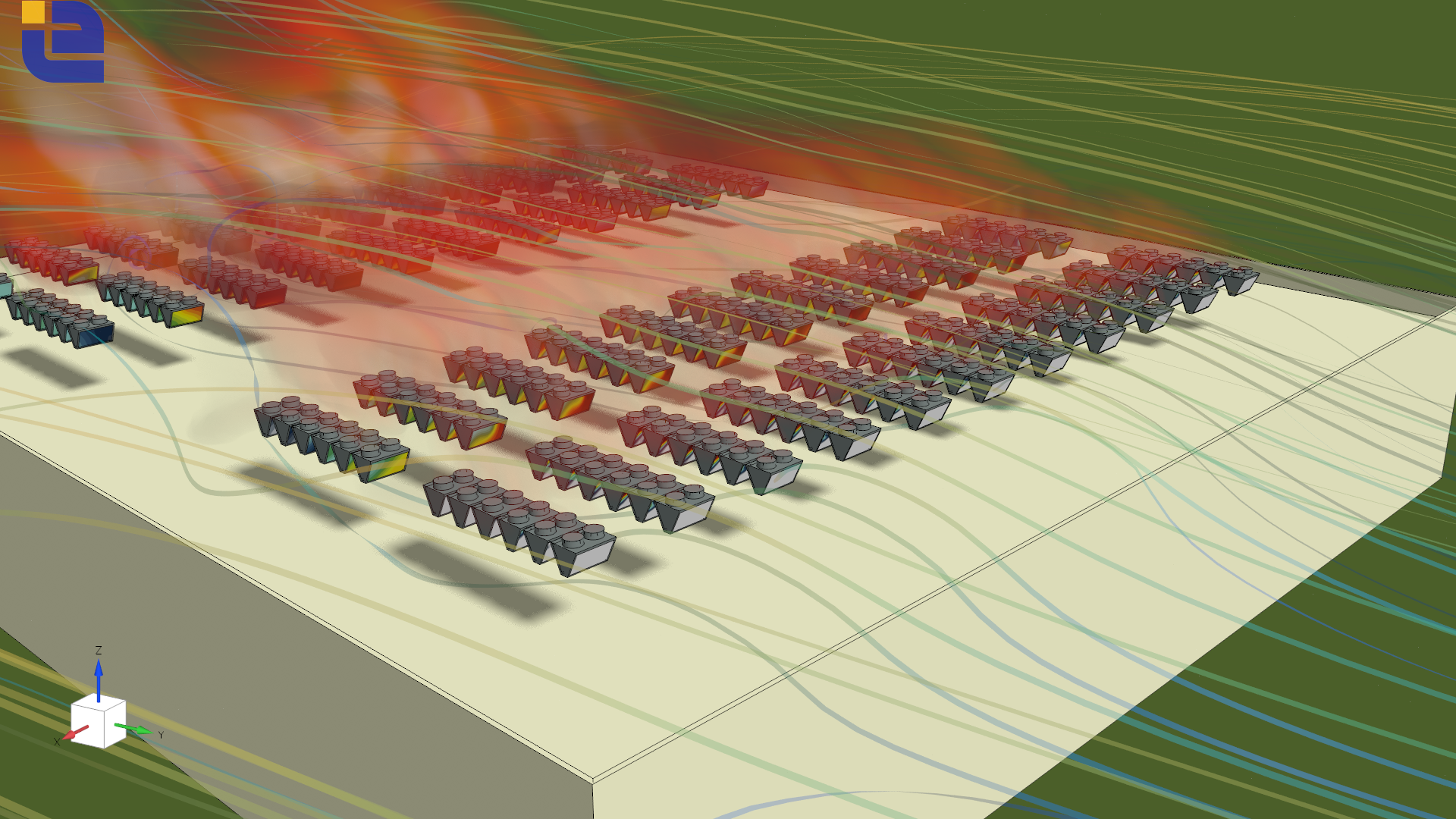
Atmospheric boundary layer and exhaust dispersion
Flow across real terrain is not an average velocity through a wind tunnel. An atmospheric boundary layer model captures height-dependent velocity and turbulence profiles along with ground characteristics, which is what makes the following questions answerable:
- Hot air recirculation from chillers and cooling towers that quietly limits capacity.
- Generator exhaust and pollutant dispersion paths that re-entrain into fresh air intakes.
- Downstream thermal and pollutant plume impacts of a full campus.
Transient failure and thermal ride-through
Static models tell you whether a room is cool under normal operation. Transient models tell you what happens when something breaks. We simulate CRAC and CRAH trips, cold tank storage response, pump failures and power transfer delays to calculate real thermal ride-through times against ASHRAE envelope guidance.
A static model answers a question nobody loses sleep over. The transient case is the one that ends up in the incident report.
What this is worth to a design team
- Prevent expensive redesigns. Catch thermal short-circuiting, localized hot spots and flue gas recirculation during design rather than at commissioning.
- Support uptime commitments. Hand the operator verified thermal evidence instead of an assurance.
- Win high-density bids. Offer hyperscale and enterprise clients tier-one simulation as part of the proposal.
Inquire Engineering partners directly with MEP and architectural teams to deliver high-fidelity STAR-CCM+ simulation for data centers and mission-critical infrastructure. If you have a high-density design that has to be right the first time, start a conversation.